
The Biological Mechanics of Spider Movement
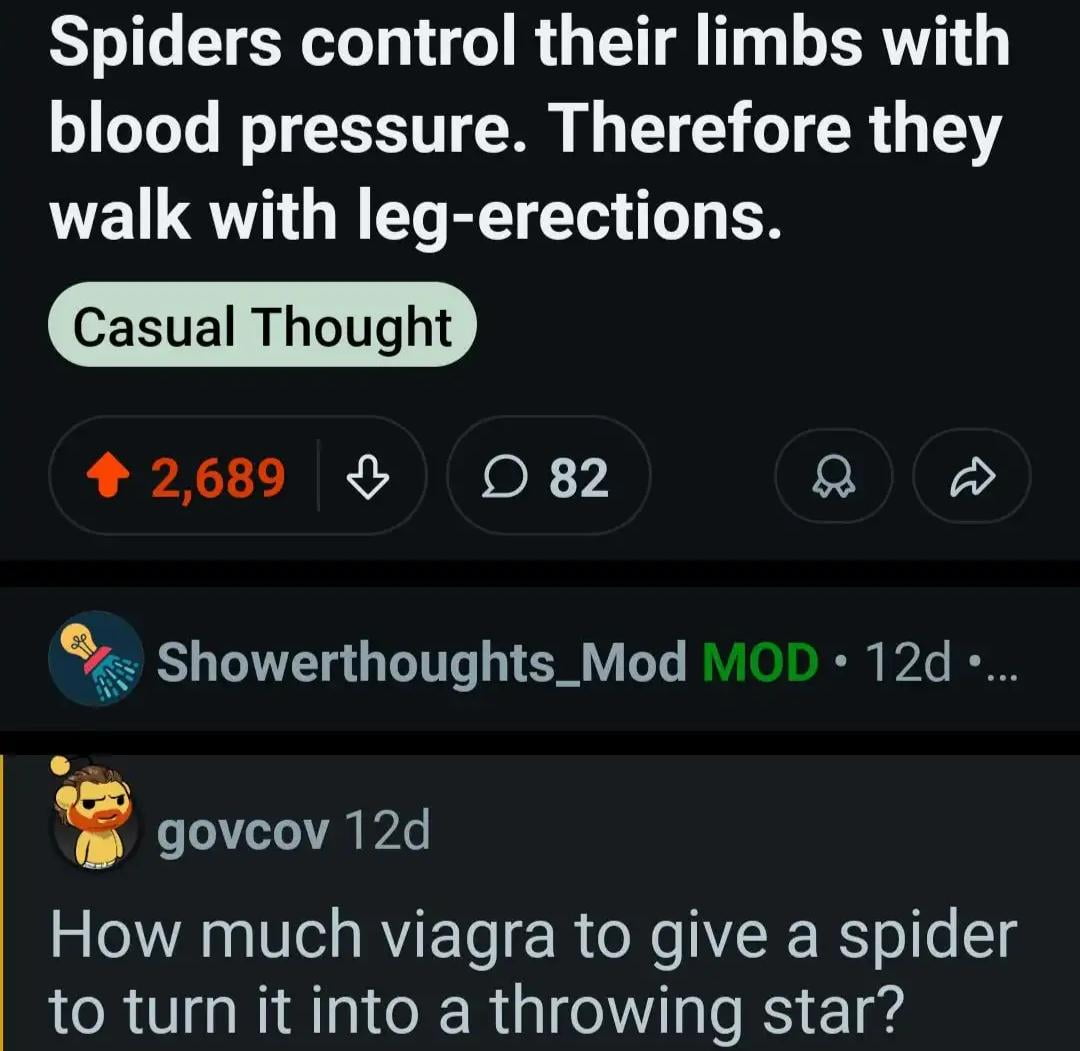
This post highlights a biological fact regarding how spiders move. Because spiders lack extensor muscles in many of their leg joints, they rely on hemolymph pressure—a fluid similar to blood—to extend their limbs. The provided image presents a humorous take on this physiological process, suggesting that spiders essentially walk using a form of hydraulic pressure. The accompanying commentary playfully extrapolates this concept, questioning the potential effects of performance-enhancing substances on arachnid anatomy and movement.


i remember seeing a big spider on my ceiling as a kid and i tried to catch it with a glass but it just curled up instantly like it was scared. reading this makes me realize i probably just gave the poor guy a heart attack by cutting off his hydraulic flow.
Give it one Spanish fly...
When I do heavy lifting I put high blood pressure on my arm too.
If you have ever donated blood, you could be in someone's boner right now.
The Brazilian Wandering Spider: A bite from this venomous spider can cause a painful, long-lasting erection known as priapism. So spiders can be used instead of viagra in a pinch.
That's why when they die the spider legs go all up because no more pressure.
We had a large writing spider on my porch the other day I blew a lung full of weed smoke to it and he immediately quit building his nest curled up and proceeded to chill for the next hour before he got back to work. I threw several moths and such into his web though to take care
Scientists: do your duty. Mankind must know the answer.
Spiders do not have blood. But yes, hydraulics is how they move. Exceptional creatures, I used to breed them and must say it was probably the best hobby I've ever had.
Well another fun fact, stone spider bite could cause a man to get erected for hours if i'm not mistaken
About 0.0125 mg per gram of spider