Captain here: that green marble is Valonia ventricosa, nicknamed sailor's eyeballs. Smithsonian Ocean notes each bubble is a single cell that can reach about 5 cm across. Guinness lists it among the largest unicellular algae, coenocytic with many nuclei inside one membrane.
T
the_weiNewcomerNov 6, 2026
I thought it was an ostrich egg?
P
park.jihoNewcomerNov 6, 2026
If we had known about multinucleated cells, this would have impressed us less
M
mateus_95xNewcomerNov 6, 2026
The forbidden grape
M
mei52NewcomerNov 6, 2026
I have doubts if you could really count coenocytic organisms as single celled. This algae has a multitude of nuclei. It would be better to think of it as a multicellular organism where the cells dont divide but stay fused during mitosis.
S
sanne.jansenNewcomerNov 6, 2026
The largest single-cell organism is Caulerpa, a green alga genus (such as Caulerpa taxifolia) that can grow up to 10 feet (3 meters) long.
R
realthandiNewcomerNov 6, 2026
The mitochondria on that thing could power a house
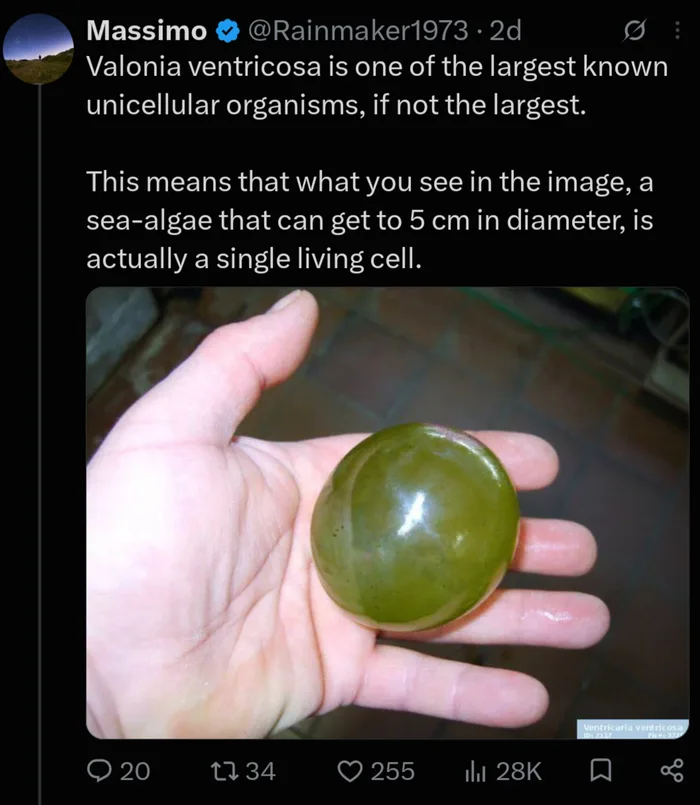


Captain here: that green marble is Valonia ventricosa, nicknamed sailor's eyeballs. Smithsonian Ocean notes each bubble is a single cell that can reach about 5 cm across. Guinness lists it among the largest unicellular algae, coenocytic with many nuclei inside one membrane.
I thought it was an ostrich egg?
If we had known about multinucleated cells, this would have impressed us less
The forbidden grape
I have doubts if you could really count coenocytic organisms as single celled. This algae has a multitude of nuclei. It would be better to think of it as a multicellular organism where the cells dont divide but stay fused during mitosis.
The largest single-cell organism is Caulerpa, a green alga genus (such as Caulerpa taxifolia) that can grow up to 10 feet (3 meters) long.
The mitochondria on that thing could power a house
What about a married living cell?
What dose it tast like?
Imagine the mitochondria on this bad boy