
Why Diacritics Are Essential for Avoiding Unintended Meanings
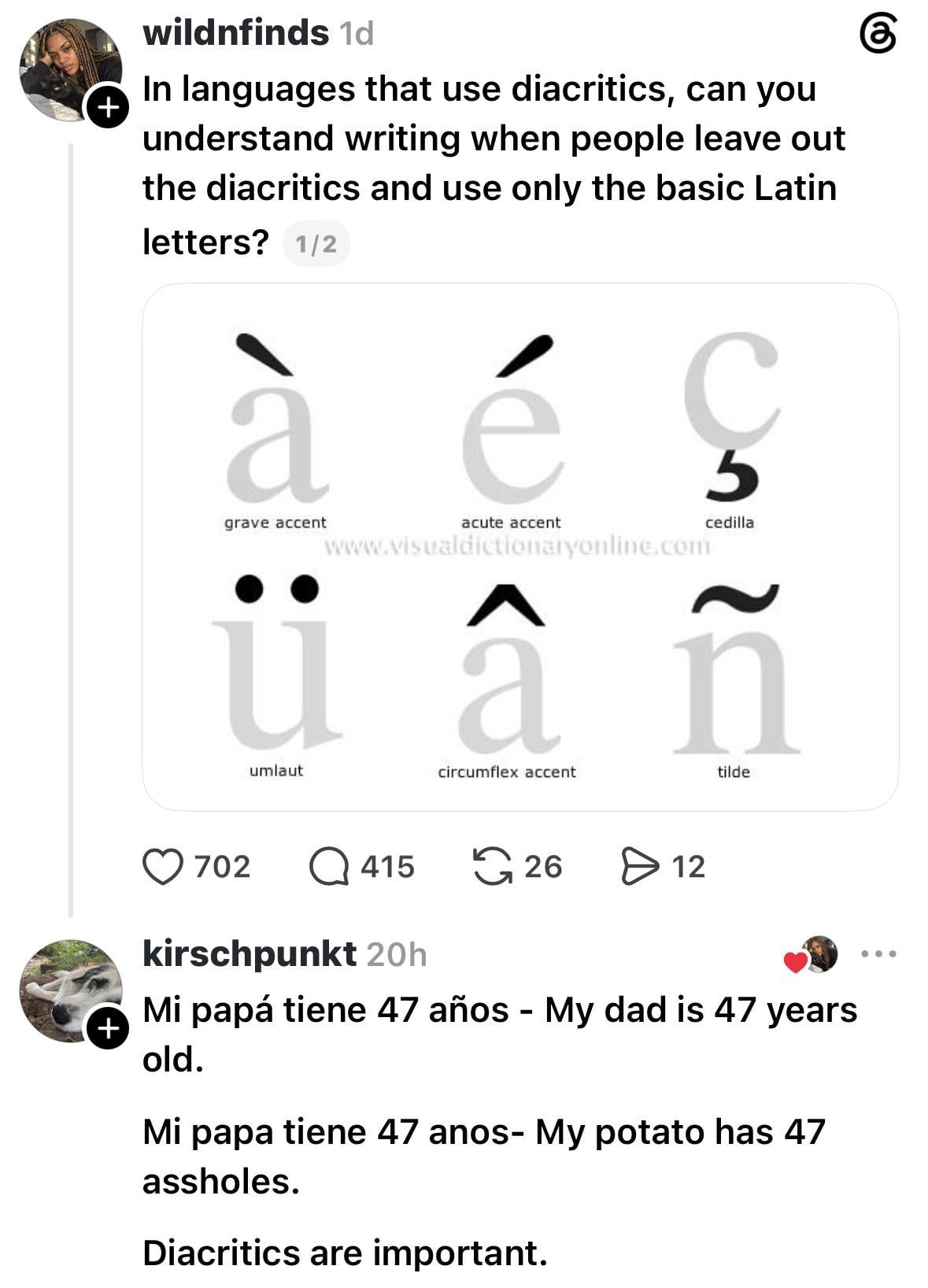
A social media discussion highlights the critical role of diacritics in language. While some argue that context often clarifies meaning when accents are omitted, others point out that missing marks can drastically alter a sentence's translation. The post uses a Spanish example to demonstrate how a missing tilde changes the word 'años' (years) to 'anos' (anuses), turning a simple statement about a father's age into an absurd claim about a potato. The post serves as a humorous reminder that diacritics are not just decorative, but essential tools for precise communication.
Ok but with context and all you understand
Anyos vs anos. Pronunciations differ too.
That reply misses the best part! A capital letter changes it even further: Mi Papa tiene 47 anos > My Pope has 47 aassholes
depends. back in the early days of the internet when text encoding wasn't unified people would omit diacritics to avoid weird symbols. the text was more legible that way
in Czech you can mostly understand everything without diacritics from context. But it does change the meanings of words - být (to be) byt (apartment) pás (belt) pas (passport), most (bridge) mošt (juice)
In polish Sad - orchard Sąd - court
Most of the time you can still understand it though
Polish: robić łaskę - do someone a favor robic laske - give blowjob somebody..
In Hungarian: - Szárnyalás - flying high - Szarnyalás - licking shit Yup. Kinda important.
in other words, yes, we can, cause most of times the wrong phrase doesn't make sense